What Walks Out the Door: How to Capture Tribal Knowledge Before a Key Staff Member Leaves
A key staff member is leaving, and too much of how you actually work is only in their head. Here's how to capture it before it walks out the door.

On this page · 6 sections
- The Week You Find Out They're Leaving
- What Only They Know, and Where It's Hiding
- Walk One Role All the Way Through: A Senior Bookkeeper Getting Ready to Retire
- Why the Wiki You Already Have Goes Stale
- When a Wiki or Off-the-Shelf Tool Is Enough
- How to Capture Tribal Knowledge Where the Work Already Happens
Over the past several weeks, I've been in a lot of conversations with small business owners who aren't in tech. Plumbers and electricians all the way to accountancy and legal firms.
The interesting thing is how often those conversations come back to the same practical pain: someone on the team knows all the exceptions, and the owner has started to wonder what happens when that person isn't there.
That's what I wanted to write here.
You've probably had a version of this week already, or you can feel it coming.
They walk into your office and tell you they're leaving. Maybe they're retiring. Maybe they've taken another job. You're genuinely happy for them. Then, about four minutes later, the other questions start.
Who actually knows how they do month-end? Where do the files live? What's sitting in their inbox that never made it into the system?
If you think about it, the hard part isn't replacing them on the roster. It's everything they know that never got written down.
A lot of people call this tribal knowledge. It's a slightly awkward phrase, and I wouldn't get hung up on the words. In plain English, it's the stuff only one person knows: the judgement calls, the exceptions, the "just ask them, they know" shortcuts that keep the work moving and never quite make it into a document.
So who is this piece for?
If you run an established trade or professional services business in Australia, roughly five to fifty people, and too much of how the work actually gets done still lives in one person's head, this is for you.
Let's get into it.
Short answer: When a key staff member is leaving, skip the Friday brain dump. Map what only they know, capture it in the tools you already use while they run the live task, then prove someone else can do it before their last day.
The Week You Find Out They're Leaving
The first instinct is usually a Friday brain dump.
You ask them to write everything down before they go. They spend their last days in a document nobody will be able to use, and you still find the gaps after they've left.
It's an understandable reaction. It's also the path of least resistance, and it rarely works.
So skip "who replaces them?" for a moment.
The better first question is "what does the business actually lose?"
I came across an Australian HR piece that puts this pretty plainly: when a key person leaves, they can take part of the business's story with them.
The live client matters. The mailbox. The conversations that never made the file. (Integrated People Solutions)
The week they hand in their notice is late to start. But it's not too late to be deliberate.
Start with the live work, the logins, and the unofficial workarounds. Capture the things that would stop the business if they walked out tomorrow.
What Only They Know, and Where It's Hiding
A written procedure is not the same as transferred knowledge.
The procedure says what to do. What only they know is the judgement: why this client is handled differently, what to check when the official step fails, and which shortcut everyone uses but nobody has written down.
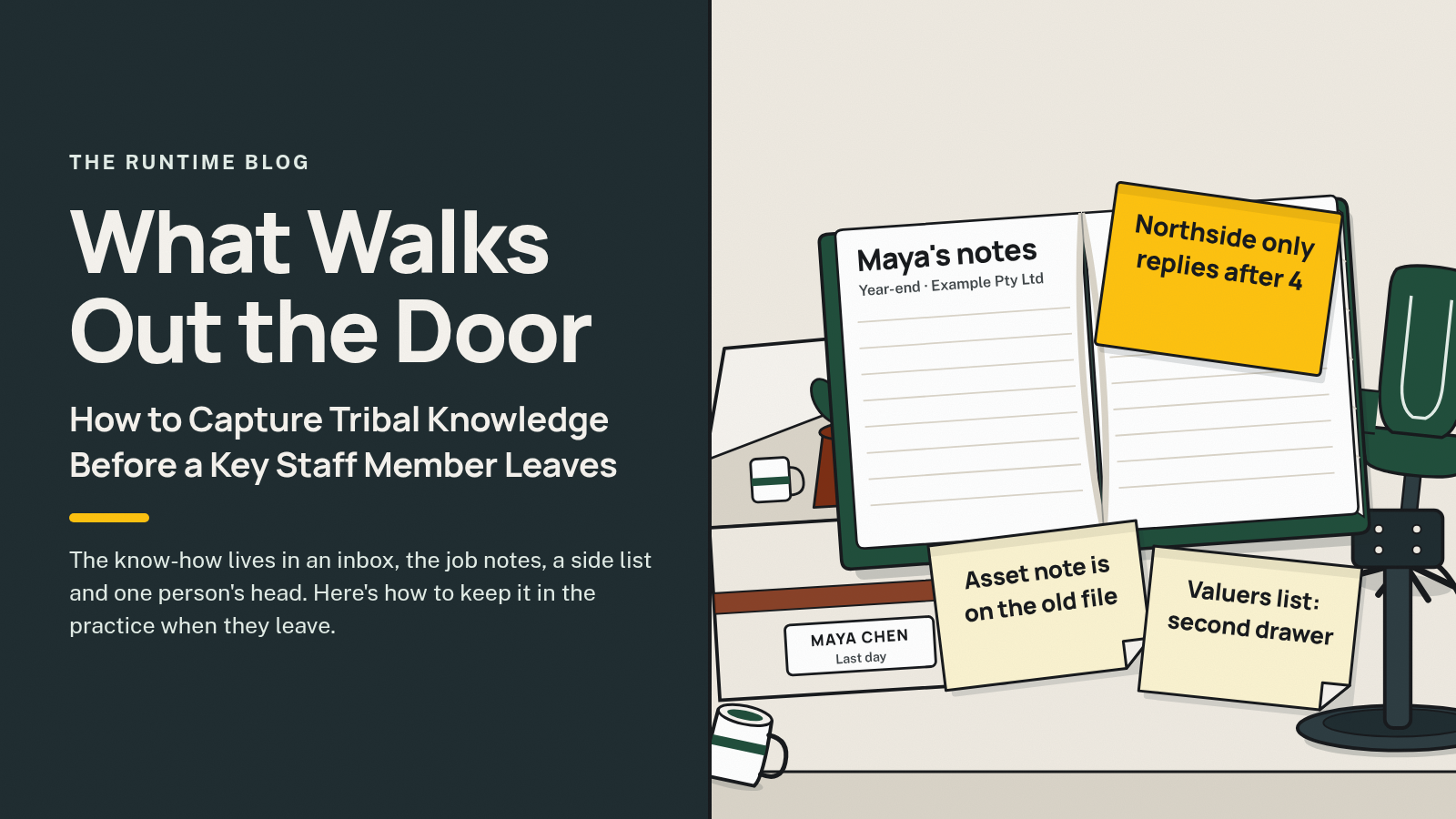
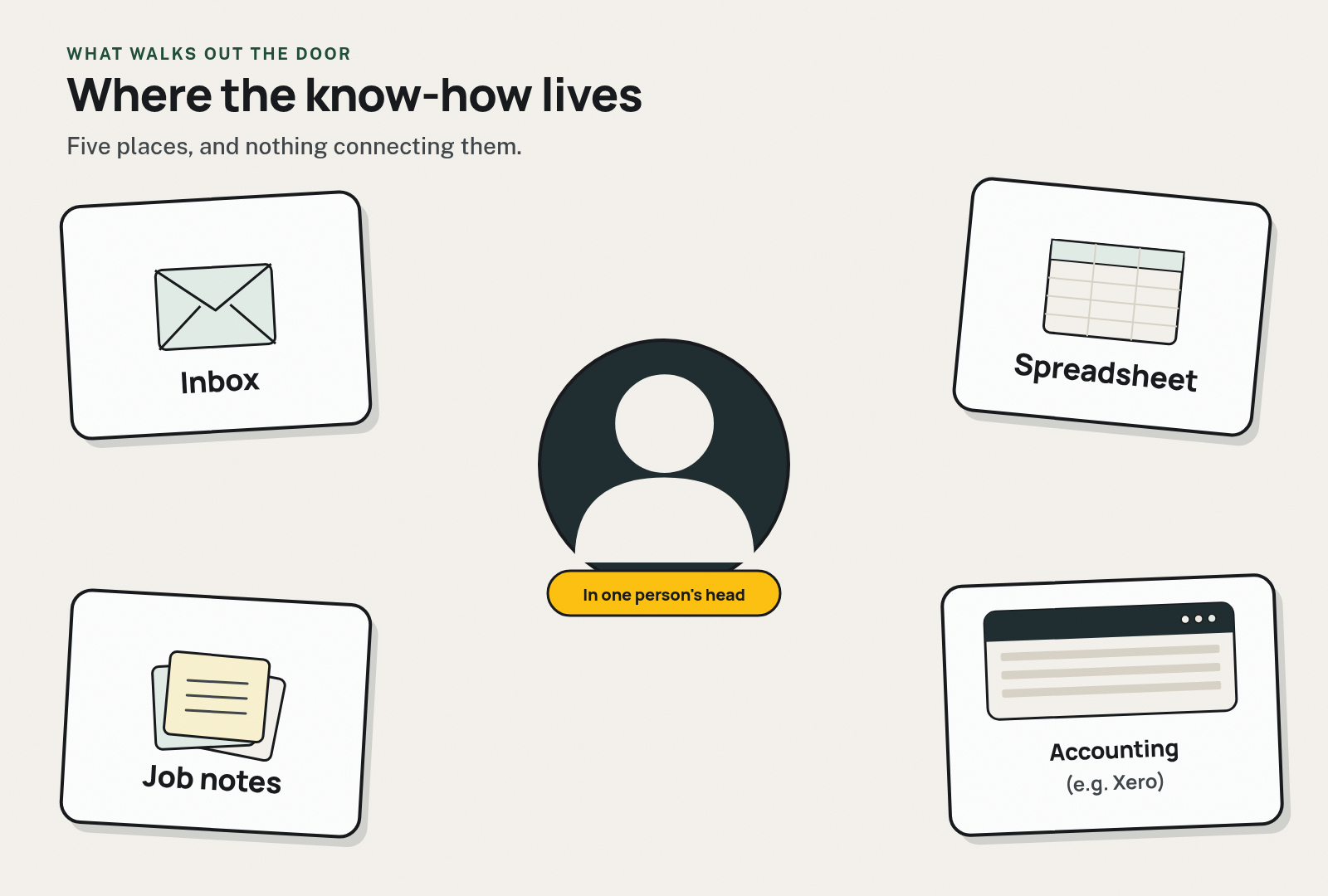
And it usually isn't sitting in a manual. It's in their inbox, job or client notes, a spreadsheet on their desktop, the way they use Accounting (e.g. Xero) or the job software you already pay for, and conversations that never made the file.
This isn't only a feeling. You can find owners on forums asking how to stop losing knowledge when someone leaves, and how to get what only one person knows out of their head. The pattern is the same: a wiki nobody updates, recordings nobody watches, documents written in a panic after a resignation. (r/smallbusiness; r/Accounting)
A simple litmus test is this: would you be stuck if they took four weeks off?
- Only they can finish a critical task. Month-end, a diagnostic, a renewal, a particular client's work.
- A client or supplier relationship sits with them. The history is in their phone or their inbox, not in the file.
- The history behind a process sits with them. Why it works this way, and what happens if you follow the official steps.
- You're still the fallback. If they're away, the question comes back to you.
If two or more of those are true, you already have a key-person problem.
Walk One Role All the Way Through: A Senior Bookkeeper Getting Ready to Retire
Let's make this concrete.
Say Sam is your senior bookkeeper. (A fictional name, for illustration.) They've been with you for years, and they've just told you they're retiring in a couple of months.
Don't start with a blank document titled "everything Sam knows". Walk one real cycle with them.
Sit with them at month-end. Watch how payroll exceptions get handled, and what they do with the client who always sends the wrong report. Ask them to show you where the emails and files actually live, not where the shared drive says they should live. It's the same split I wrote about in Who Are We Waiting On? The job sits in one system, and the conversation sits in another.
Bookkeepers talk about this exact trap: trying to write a giant "client bible" of every quirk, which is out of date within a month and too long for anyone to open. The useful stuff is shorter, and it belongs on the client or the task, not in a separate encyclopaedia. (r/Bookkeeping)
| Where it lives now | Where the next person should find it |
|---|---|
| Sam's inbox | The client or job record, with a named owner |
| A private folder or desktop spreadsheet | A shared process, against the right client or job |
| "Just ask Sam" | A short note on the recurring task, in the system you already use |
| A workaround only Sam remembers | The process itself, once someone else has run it successfully |
If you're in the trades, the pattern is the same. A lead technician holds the site history, the diagnostic quirks, the "ring me if the unit does this" knowledge. The next person shouldn't have to call them after they've gone. They should be able to find it against the job.
Why the Wiki You Already Have Goes Stale
Most firms already have somewhere to put this. A shared drive. A wiki. A folder of procedures.
And most of those go stale.
The irony is that we treat documentation like homework. We ask people to stop doing the job and go write about the job, usually after hours, usually with no one checking whether the page is still true six months later.
We all fall into this. I've come to realise it's not a discipline problem so much as a design problem. If capture is a separate project, it loses to the path of least resistance: just do the work, and answer the question when someone asks.
So we over-index on producing documents, and under-index on whether anyone can actually run the process without the original person in the room.
You also don't need to document everything. Start with the highest-risk, single-owner tasks from the checklist above. That's enough to begin.
When a Wiki or Off-the-Shelf Tool Is Enough
I want to be honest about this part.
If the know-how is already written down, has a named owner, and is actually kept current, you may not need a custom build. A shared drive can be enough. So can a wiki, or an off-the-shelf tool such as Scribe, Trainual or Guru, if your team will really use it.
If that's you, buy the tool and use it well. You don't need us for a wiki.
It's not enough when the knowledge is still scattered across email, job notes, Accounting (e.g. Xero) and one person's head, and nothing talks to anything else.
A new library beside those tools just becomes another place that goes stale.
One more thing. "Succession planning" and "key person risk" often mean ownership handover, or insurance. Those things matter. Even business.gov.au tells you to write down your processes so vital knowledge doesn't leave when you do.
This piece is about something narrower: the day-to-day know-how that keeps the work moving.
And here's the catch. A process isn't transferred just because someone wrote it down.
You have to prove someone else can actually do the work. (Nexist)
CPA Australia's InTheBlack has written about the same risk in practices.
In a nutshell: a tool is enough when the knowledge is already held in common. It isn't, when it still lives with one person.
How to Capture Tribal Knowledge Where the Work Already Happens
So how do you actually capture it?
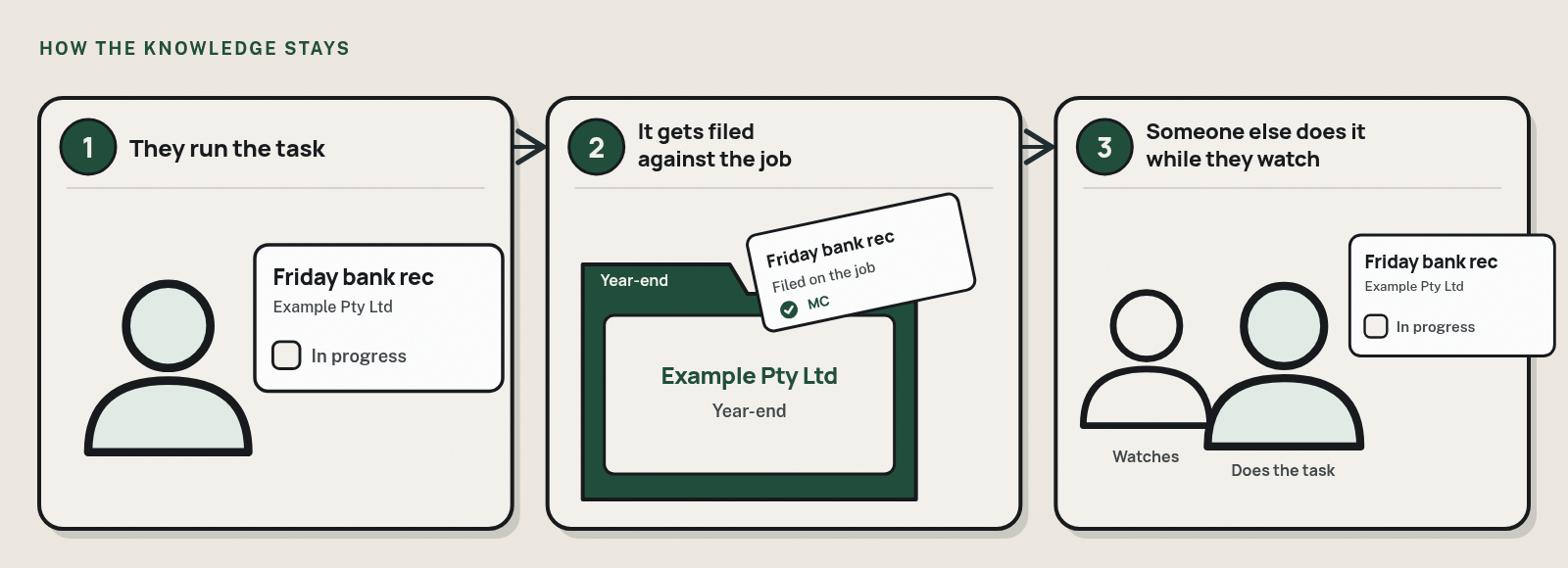
1. Have them run the live task and narrate
Not in a meeting room with a blank page. Have them run the real task once, and narrate as they go. Record that. The doing surfaces the steps. The talking surfaces the judgement.
2. File the useful bits against the job or client
Then file the useful bits against the client, the job or the process, in the tools you already use. Not in a separate bible. Keep permissions tight, so people only see what they should.
3. Prove someone else can do it before the last day
The litmus test is not "did we write it down?" It's "can someone else actually do the job?"
Have the next person run the live task with the first person watching. If they stall, that's a gap. Fix it before the last day.
A document nobody has tested is still a risk.
At the end of the day, this is a system problem, not a writing problem.
If the know-how is spread across the tools you already use, like email, job or client notes, Accounting (e.g. Xero) and your practice or job software, the first job is to map who knows what, and where it actually lives.
That's what a Systems Audit is for, if you want a hand with it. We work alongside the tools you already have. We don't replace them. You keep the blueprint either way.
If a wiki already does the job, do that. If it doesn't, feel free to tell us what's only in one person's head.
Would the business still run if they took four weeks off tomorrow?
Could someone else find the exception, not just the official step?
And has anyone actually done the live task without them in the chair?
That's it. That's the whole game.
The knowledge is already in the business. The work is to stop it walking out the door with one person.
Related posts
 Professional services
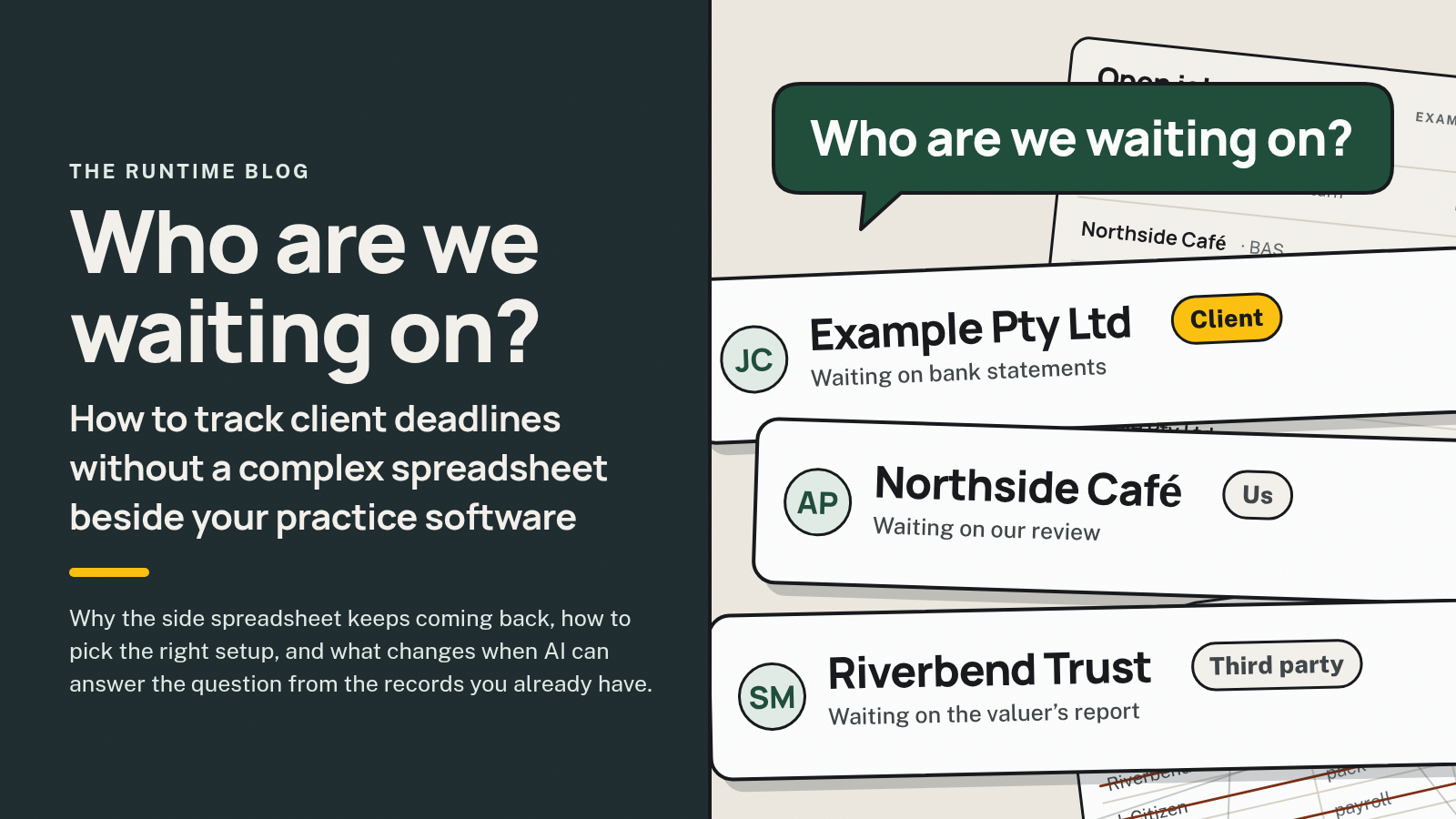
Who Are We Waiting On? How to Track Client Deadlines Without a Complex Spreadsheet Beside Your Practice Software
Tracking what's due and who you're waiting on shouldn't need a spreadsheet beside your practice software. A plain-English guide for Australian accounting firms.
11 min read
 Professional services
AI for Accountants in Australia: What It's Actually Good For
Plain-English guide to AI for Australian accountants: what it drafts at tax time, how it connects to Xero rather than replacing it, and what stays with you.
16 min read
 Trades and field service
What AI Can Actually Do for a Trade Business
Honest, plain-English guide to AI for Australian tradies: what it can do across quotes, bookings and invoices, what it can't, the risks, and a checklist.
14 min read